Featured

Why I write..

It took a pandemic to change the world. We were busy in our lives and then the pandemic hit…the world shut down…a sense of panic gripped everyone. Everything went into a state of lock down except for us in the health care world. Never in my wildest imagination did I dream of the ICU and pulmonary medicine being pushed into the forefront of health care. We have shows on television about trauma, life in the Emergency Room, about weight-loss surgery but never about what goes on in an ICU- which along with the emergency department is the most happening place in the hospital.

The ICU…what is it? A place where patients come when care cannot be delivered in the regular part of the hospital. In the ICU they fight for their lives. Fighting with them are the care team (physicians, nurse practitioners, physician assistants, nurses, respiratory therapists, environmental services, etc.). Families come to see their loved ones on “life support”, emotions run high as they advocate for them. During this last year I have had difficult conversations with families. Comments about mistrust, being told what to do with treatment protocols, demanding care, families googling information and the most remarkable comment was, “transfer my loved one to a republican hospital so they can get the care Trump received”… what people do not understand is that we all fight for their loved ones- those patients who lay on the bed in ICU are our loved ones and we fight for them day in and out…the entire team does without expecting much in return.

We have heard wonderful things, actions of love and great feedback. This pandemic has tested humanity in more ways than any pandemic before it. Some battles are won others we lose…we are human too we have emotions we feel, we hurt, yet we process and move on and that is what those on the outside may not understand. We in the ICU grieve privately as we are on the forefront…yes we are human and please look at us in a different light and that is why I write….

Iqrah is the arabic word to read and that is why I write… to communicate with those outside the ICU as to what happens, the encounters we have, the people we treat and meet. Please read with care…read with love…read so when you are in an ICU for any reason please understand that those who care for you have emotions as well… they are there not only because it is their job…but because they care!
Reflections 2021

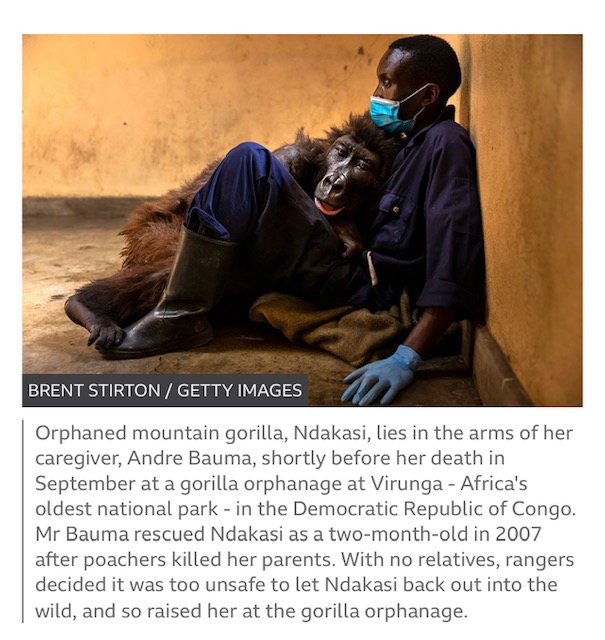
As I scanned the BBC’s 2021 in pictures, 2021 reflected in the two pictures below. In the first picture, emotions seen on the faces of the man and the gorilla are reflective of what we have been through in healthcare under attack from Covid 19 and its variants. We are all fatigued and tired, both emotionally and physically. It has taken a toll on all of us in healthcare as we see what this virus can do. Yet we are here to help support those in need. We have sacrificed our lives to help humanity and for the future, a brighter and healthier future. The way the gorilla is looking at the man is how we have had patients look at us, where words are not needed and emotions and looks are enough to communicate. We have all trained to do the best we can, to save lives, to provide the best care and to heal. The man took the gorilla when he had no hope, became his best friend, his care giver, his healer and towards the end of his life the look on the gorilla’s face is all the man needs, no words are necessary, he sits there holding him in his last moments, enjoying and reflecting on bond they have built together. We in healthcare too have had many such moments where we created these bonds and that is what keeps us going.

For some we could not change the outcome but remember them, we pray for them and their families. We pray for awareness, for myths to be dispelled and for a healthier and safer world.

BBC’s 2021 in pictures: Striking photojournalism from around the world

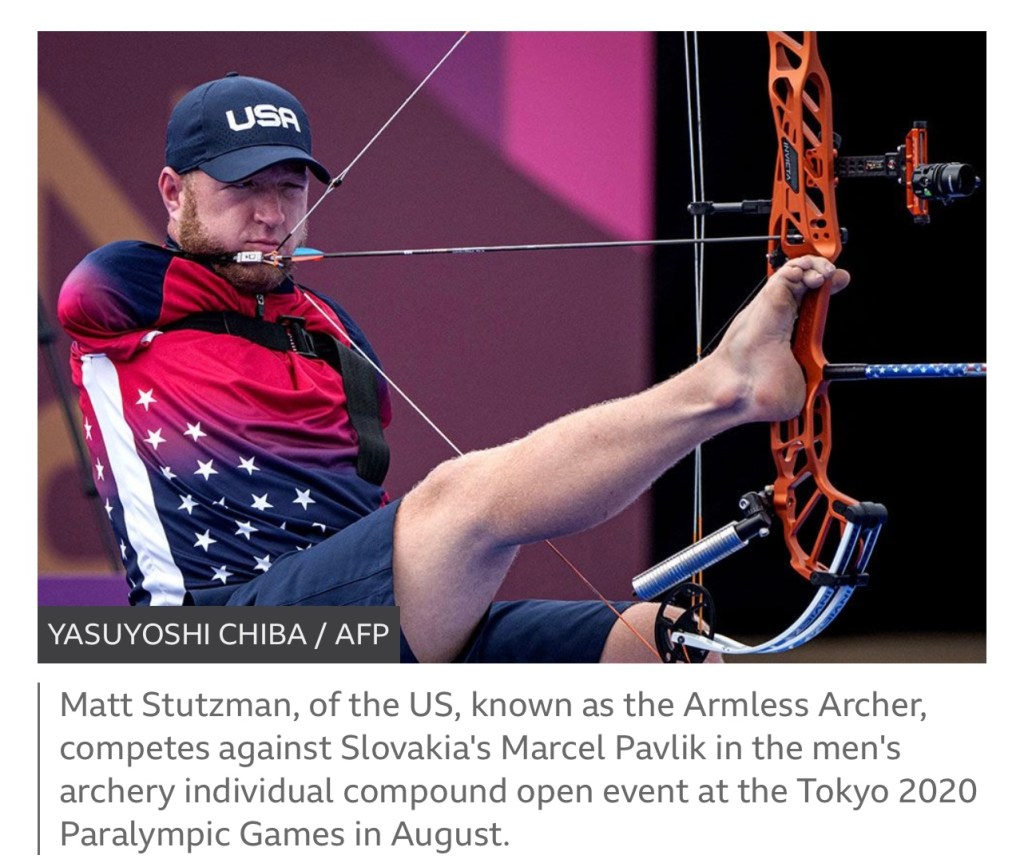
In the second picture, we see a man who has an expression of determination. He has survived all odds in life without his arms, yet he is competing at the top of his sport in the Paralympic games. Many times, in this past year, we felt we had no arms, we felt disabled for the monumental task ahead, yet as a team we pulled our resources together and continued to move forward. We looked at each other for inspiration and we survived at the top of our game caring for those who needed our help in the hospitals across the country. Each time a “code blue” was called we responded and if the outcome was not good, we reflected for a few minutes on who the patient was, said a small prayer and we healed each other. We left the room ready to take care of what lay ahead of us.

BBC’s 2021 in pictures: Striking photojournalism from around the world.

2021 was the year where I took the step to write my stories, I would like to thank all of you for taking the time to read and provide feedback.

May 2022 be a year of hope. A year where we support each other not just in healthcare but in every aspect of life. I pray for a safer and healthier 2022.

May God Bless us all!

Christmas Morning in the ICU

Driving to the hospital on a Christmas morning encountering 15-20 cars is typical. I usually get there a little earlier so I can get the night team out so they can head home to spend Christmas morning with family and loved ones. Hospitals are usually quiet with bare minimum staff and few visitors. Suddenly we hear “code blue, code blue” over the speakers and we forget its Christmas and run to the room announced overhead. We arrive to see a middle-aged male seizing and after stabilizing his airway and seizures, he is rushed for a CT. Results show a large area of bleeding with impending herniation. Family is called and, on their arrival, latest information is shared that he is not a surgical candidate. We leave family to absorb the information and continue to care for our patients. Like all mornings, this Christmas morning is no different in ICU.

In my years as an ICU physician and in my personal life, I have seen life change in an instant time and time again. Losing my father suddenly after a fatal cardiac arrest within hours has always helped me speak with families and allowed me to relate to them. My mother has been a rock after my father passed away and has taught me so much. Recently my world shook again when my brother called that my mother had a stroke. I flew to be with her as I know how fragile life can be. As soon as she knew I was coming, she expressed her disappointment that she may not be home to welcome and cook for me Fortunately she was discharged hours before my flight landed and when I arrived at my brother’s home in Boston she was there. She is recovering slowly and is very motivated to be independent again. My mother is truly a blessing in my life. Even in her time of not being well, she thought about others and how they would feel, these are the core values I have held on to in my life and in my career.

Covid 19 has tested us all as humanity. It continues to do so with new mutations every few months. As healthcare teams, we have bonded and supported each other. Christmas is a time to celebrate and be with family. It is a time of year when the darkness of the evening is replaced by lights. Homes, places of work and worship are decorated. In the ICU, we are the beacons of light when all else fails. We try to keep the light on but sometimes we cannot as that is the limitation of us being human. Yet, we are always positive to help those in need and to respond with the best of care and character. May this time of year be spent with loved ones and may we all look to a brighter future and a year ahead.

Coordinating care for patients and stepping out for a moment to enjoy the lights!

Will Hurricane Covid season ever end?

Hurricane Covid hit the US mainland in the Spring of 2020. Unlike most hurricanes that come up the southern coast of the US, this one started in New York and spread throughout the United States. As we do during hurricanes we prepare, we hunker down, gather supplies, and hope and pray that minimal damage is caused as the storm passes through. This storm was different. Its intensity was miscalculated by the administration at that time and therefore we were totally caught off guard. We did not learn from other countries across the Atlantic (UK, Italy, etc.) and tried to be like the ostrich and bury our head in the ground and hope the storm just passes through. Unfortunately, it did not just pass through, and it was the worst of storms to have hit the United States and the rest of the world in modern history.

Like a category five hurricane it caused extensive damage and left permanent scars in people lives and specially the lives of those of us in healthcare. Here in Florida when we have a hurricane headed to our cities we go into lockdown at our hospitals and that is what we did. We worked tirelessly to help slow the surges of Hurricane Covid as its squalls kept battering us. We used what we had at hand, we adapted, we quickly learnt what we could to help save those who were most at risk and those patients who were coming to the hospitals. We went into lock down; mask mandates were placed to stop the spread of the virus. We were caught off guard, with this came misinformation which spread faster than the gale force winds of a super storm, and with the help of social media and the experts on social media mistrust was spread through the United States.

What did it leave in its aftermath?

  1. More misinformation that at the start of the storm.
  2. Everyone and anyone who may or may not have a medical background is now an expert in Covid 19, its treatment protocols and vaccination.
  3. A record number of deaths, with numerous families who lost loved ones.
  4. Permanently scarred lungs and majority of survivors of severe covid 19 left with some respiratory complaints.
  5. A tired and exhausted medical work force.
  6. Information obtained on social media may be more misleading and little information is dangerous

What we learnt:

  1. Even though we pride ourselves as the best medical system in the world we were barely able to sustain such a storm. A Cat 5 storm like this will expose our healthcare system.
  2. A tired and unappreciated health care work force who withstood the worst of not just Hurricane covid but of the social media misinformation storm as well.
  3. We lack the medical equipment to take care of large numbers of sick patients and specially the critically ill.
  4. We do not have enough healthcare personnel (doctors, advanced nurse practitioners, respiratory therapists, and nurses). One can have warehouses filled with equipment but if there are no personnel to operate the equipment then it is of no use.
  5. There needs to be a national database of health care personnel who can be moved from region to region in case of a pandemic to take care of patients. Treatment protocols should be standardized, and artificial intelligence can be used to create algorithms to predict outcomes, smart pumps, and smart ventilators.
  6. Burnout is real and needs to be addressed by hospital leaders.

After any storm, the cleanup is still ongoing. We in health care are trying to catch up physically, emotionally and spiritually. Planning and strategizing against the next Hurricane Covid  variants to strike us and to be prepared. As the African proverb so aptly suggests, “it takes a village to raise a child”, it will take the entire community armed with realization and awareness to help fight  the next Hurricane Covid.  The cleanup has not finished and  a new variant has emerged. Hurricane Covid- Omicron has emerged in southern Africa and spreading. Travel shutdowns and quarantine is being reinstated as we get more information regarding its potency. We await to see what it will bring to our shores here in the USA.  

Hurricane Covid season will not end soon, there will be another variant and then another that will emerge somewhere in the world. What we need is not to panic and  listen to the experts- the true experts not the self-proclaimed social media gurus who do not have a back ground in science as little knowledge is dangerous.  How should we prepare for the next hurricane. Just like we did for the last few hurricane Covids’ we should continue to mask, practice hand hygiene and maintain distances as best as we possibly can.  Protect ourselves with vaccination and get vaccine boosters when advised. Hurricane Covid is here to stay unfortunately for some time. But together as humanity we can form a wall that can eventually help eradicate hurricane Covid.

Being Thankful

Last year at Thanksgiving, we as a country were under lockdown. We could not meet our loved ones and virtual thanksgiving dinners replaced the traditional gatherings.  No one knew what the future would hold. We could not in our wildest of imagination think a virus would cause such massive worldwide lockdowns. Today, we as a nation and the world are in a better place. The unknowns that we had about Covid 19 are clearer, we have vaccines and other new treatments on the horizon to battle the scourge that caused the worst pandemic yet known.

Humanity is resilient and we survived!  We found support in unlikely places.  In healthcare, we supported each other and realized we had a larger family that we never knew existed. We were and are thankful for each other.  We found new friends.  Lives changed.  Yes, today at the table we may not have loved ones who lost their fight against Covid, some before the vaccines and some after the delta variant.  We remember them all.  We remember all the battles we fought in our ICUs and hospitals for those on the hospital beds.  We were not looking for accolades, a simple thank you would have been enough.  Unfortunately, because of the misinformation about Covid 19, we were constantly having to prove that we were doing the right thing.  A patient’s daughter told me that her mother on that ICU bed was her loved one and for us as the medical team she was just a patient. My response to her was that every patient in this ICU is treated like a loved one as we put a lot of time and energy in caring for these patients. The care we deliver to a patient with severe Covid 19 can only be done if we treat the patient like our own loved one.

We had thankful families who brought donuts, bagels and pizzas demonstrating their support to us, for all that and the positive sentiments we are thankful. This thanksgiving we can meet and hug our loved ones. We can be close to them and share food at the same table.  We are thankful to the scientists and companies that helped develop and distribute the vaccine including those who helped evaluate the vaccine.  We are grateful to all the dedicated individuals in healthcare who  administer the vaccines in malls, community, mobile clinics and pharmacies so we can once again return to some normality of life.

I am thankful to all those who have made these last 18 months of Covid 19 bearable –  family, friends and everyone who collaborated with me tirelessly for a better tomorrow.  Hug your loved ones tighter, enjoy the meals, the voices the conversations around dinner tables and let laughter fill our homes.  We can now understand the significance of thanksgiving as we too survived just like those who gave thanks as they survived in a new land.  We have a new era – the post covid 19 world and how it has changed us. Enjoy this thanksgiving and do not forget the healthcare workers who have worked and continue to work on thanksgiving.

May God bless us all.

COVID 19 veterans

As Veterans Day approaches, I cannot begin to imagine the bravery and valor of the young men and women who charged into battle, sometimes with the most rudimentary equipment and resources but still stayed steadfast to the cause they believed in. They were in trenches, landed on beaches, and even
as warfare modernized and foes became distant, their spirit of bravery and passion to the cause of freedom remained unchanged. Their ultimate sacrifice gave us the freedom in which we believe. Those Veterans are the heroes we remember on Veterans Day.

These past 18 months have been challenging for those of us in healthcare. Covid 19 spread like wildfire from China to every country on Earth and it was the true WORLD WAR that we in health care fought. We went into battle, true to our oath that we take when we graduate from our respective schools in healthcare. We rushed into battle with Covid 19 sometimes with meager resources, with limited provider teams, yet we never stepped back. On our Covid units whether they were in PCUs or ICUs we fought tirelessly and with determination. We did not know our enemy well, yet we were not afraid as we were the only form of defense, and we did it for humanity. We constantly molded to information we received from healthcare professionals from around the world, we constantly tried to navigate the challenge that Covid 19 placed before us. In regular warfare, soldiers train with different scenarios but for us in healthcare we could never have imagined the challenges Covid 19 placed before us. Yes, just like in any battle there are casualties, and we had many. We have patients left permanently scarred from the virus. With the blessing of social media, we had ease of exchanging information regarding the constantly changing landscape of the war against Covid 19 and along with it came the “social media experts” on Covid 19. Everyone was a Covid expert, and that made our job in the battle against Covid 19 even more difficult. We constantly had to defend our treatment protocols (which were put together and constantly updated with data). The question we asked ourselves was would someone with no training in warfare be allowed to advise a general on how to fight a war?

The first wave of Covid 19 came in April to September 2020. We were exhausted as case numbers came down finally after vaccines were approved in December 2020. Million wanted to get vaccinated and as companies worked overtime to make more vaccines available, we thought we had a defense against Covid 19. Then we had the vaccine naysayers and with the help of social media spread this wave of misinformation regarding Covid 19 vaccines. This led to another wave of Covid 19 with the Delta variant from July to September 2021. Majority of the cases were seen in unvaccinated individuals and once again those of us in healthcare stepped into the battlefield, donned our gowns, gloves, protective eye and face coverings and walked fearlessly into the rooms of those infected with Covid 19. We lost patients, young and old, pregnant mothers some of whom delivered and then lost their battle with Covid 19, leaving behind infant children. Yes, we had trained for years to manage sick patients, but this was and is different. It has tested us mentally and physically. 

Our toughest battle with our elite troops in healthcare was fought in ICUs where we cared for the sickest Covid 19 patients. We had some successes but a lot of failures. We defended in the best way we knew. Now I know how those troops who parachuted behind enemy lines without much information must have felt. They were the heroes who provided further reconnaissance. To all those and to all Veterans we pay tribute on Veterans Day.

We who are the Veterans of Covid 19, continue to remain on the battlefield in the ICU are tired. We are exhausted. We hope and pray that we never see what we saw a few weeks ago in our hospitals. We urge people to get the correct and reliable information from those of us who have been in the battlefield of Covid 19 and not from those who have never seen a sick patient with COVID 19. Will we ever be remembered as the “Covid 19 veterans” who fearlessly stepped into unknown and unchartered territory to save humanity as we believed in our cause?

“And whoever saves the life of one person is as if he has saved the life of the whole of mankind” (Quran 5:32)

May God bless our Veterans and may God bless us all. 

Oh My God she coded

It had been a busy day in the ICU, unstable patients, speaking with families and the regular grind that we go through in the ICU. Thirty minutes left and the night team will be here were my thoughts as I had a moment to look at my watch. I told the nurse practitioner to start preparing for sign out when the admissions phone went off again. It was a sound too familiar to me. On the other end was the rapid response team member who started to tell me about K, who was breathing rapidly and needed ICU intervention right away. I told him to place her on positive pressure (bipap machine) and transfer her to the ICU. I spoke to the nurse and respiratory therapist in the ICU and told him to get the necessary medications and equipment to intubate the patient and walked up to see the patient. K was 29 years old when we met, she was breathing over thirty-five times per minute as I walked into the room with a bipap machine on her face. She looked at me struggling to breathe as I held her hand, squeezing it tightly as she felt her life slipping away.

K was admitted to the ICU. We quickly intubated her and upon review of her medical history she was an IV drug abuser and had developed endocarditis (infection on the heart valve on the right side of the heart). The infection had spread into the lungs with multiple septic emboli leading to sepsis and eventually septic shock. As we stabilized her in the ICU, her mother and aunt walked in, and I spoke to them about her condition. The distress was apparent as her mother worked in healthcare and explained to me how her daughter had gotten in with the wrong crowd and promised if she made it alive, would help her daughter change her life. I told her the best chance she had was to have the valve operated upon to stop the infection from injuring the lung even more. She agreed to that recommendation, and I spoke to the surgeon who told me over the phone “I will give her this one chance” and agreed to take her. She was subsequently transferred to the Cardiovascular ICU (CVICU) at our main facility.

I was on call the next night and heard a code overhead. It was in the CVICU. I responded to the code with the nurse practitioner next to me. We entered the room and CPR was under progress, it was K, who had just come out from surgery. Anesthesia was in the room, the surgeon arrived, we continued to resuscitate, thinking of a mucus plug, an emergent bronchoscopy was performed at bedside, echocardiogram was unremarkable and suddenly as if something magical happened she regained a pulse, and we were able to oxygenate her again. All her vitals improved albeit she was still on life support and medications. I stayed in the room as the surgeon stepped out to speak with the family. As I knew the family on my way out, I too stopped and spoke with them. They were scared and concerned. I narrated what had happened and explained the critical nature of the next few hours to days. I left the room and had a sense in my heart of what I had just witnessed that she will do well. Her recovery was slow, but she improved steadily.

Two months later, during rounds at a chronic ventilator facility, the respiratory therapist mentioned a new admission had just arrived last night and her mother was there and wanted to speak with me. I walked into the room, and it was K and her mother. She had a tracheostomy but was breathing on her own, wide awake and coherent. Her mother seeing me enter the room stood up and a smile came over her face. This was the first time I had seen her smile and she asked me if I remembered who she was. I said how can I forget. She spoke to her daughter about the first time we had met in the ICU and then after the time she had coded. Her daughter once again squeezed my hand and this time it was a different squeeze, one of being grateful, one filled with life and energy and said thank you. We decannulated (removed) the tracheostomy and a couple of days later discharged her. She is working now and has a new life. I still run into K’s mother at the hospital. On one such meeting, she told me she could never forget the night after K coded, and the moments after when I had come and spoken with her. In her own words, she described the event.

“I can never thank you enough or let you know what comfort you gave me when I saw that look on your face that night, which was not one of devastation, but a look of hope and that it wasn’t over yet”

Hope is what we in the ICU hold on to. Hope helps us deliver the care and it is hope that never dies.

The Rose

Mr. S was a gentle person. Six feet three inches, close to three hundred pounds he was a presence in the room. A kind soul who always had a smile on his face. He used to see me for obstructive sleep apnea and had a myriad of health issues. When he was not compliant with his CPAP machine or had machine issues, he would always smile, determined to use the machine, and never wanted to disappoint me and promised to do better. I got to know him well during the years and we would talk about life and how he navigated through it, learning from him as I do through all the interactions with my patients.

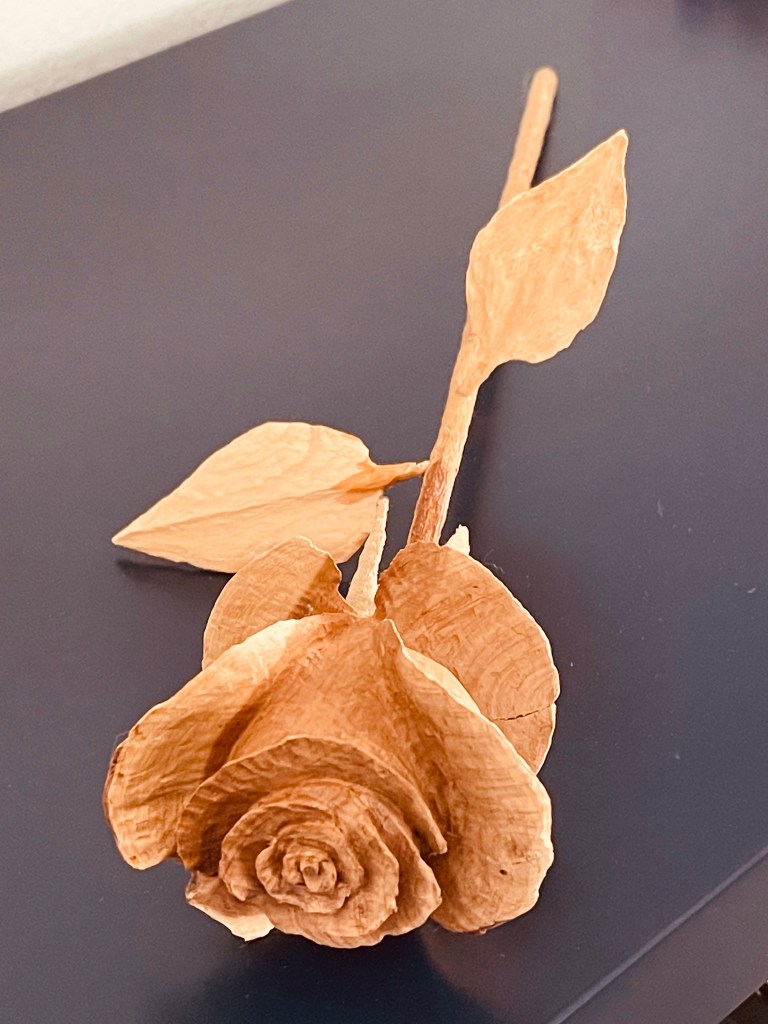
One day we spoke about work and his career, how he was now retired and happily living with his wife of many years. I asked him what he does in his free time, and he told me that he carves wooden roses from a block of wood. It took me by surprise as he was a big man with big hands and thick fingers, yet his passion was to create a beautiful delicate rose from a block of wood. I asked him what he does with the roses when he makes them. He told me, “Dr Qureshi these roses are my love and I spend a lot of time carving them out. No one knows the love and passion I put into them and therefore there is no value I can attach to them. I don’t sell them; I give them away to people as no one can ever repay me for my love that I put in them.” I just smiled back at him as there was nothing I could say at that moment that could follow what Mr. S just so eloquently said to me.

Mr. S’s condition slowly worsened over the years. His breathing got worse, weight increased and one day he presented to the emergency room with shortness of breath and subsequently went into respiratory failure and was intubated. He was admitted to the ICU, and we treated him like we treat all our patients in the ICU, with love, hoping and praying each day that his condition may improve, and he can breathe on his own. Unfortunately, his condition did not improve. During this time, I had deep and intense conversations with his wife and had developed a rapport with her as well. She rarely accompanied him to the office visits. Then came the day to have the conversation with her that her husband was not going to get better and to plan his care. She told me he had lived a beautiful life, a fulfilling one and he would not want to spend the rest of his life attached to machines. She would want to take him off life support and let him pass in peace.

However, she had one request. Apart from his family visiting, she told me about his parrot who he had for close to 15 years who had missed him since he came to the hospital. She told me the bird would sit on his shoulder as he carved the roses and requested if the bird could visit. After speaking to my nursing supervisors,  we made a special allowance. The day we planned to take Mr. S off life support, the bird was brought into the room. He was placed on his stomach and the bird walked over to his face, looked at him put his beak down on his face as if he were kissing him for a few seconds then looked at him again and walked right back to his stomach. Mr. S’s wife picked up the bird, put him back in the cage and said thank you as I stood there and watched this entire scene. She looked at me and nodded that the bird was now at peace as well. It has been close to 8 years, and I remember that moment clearly.

I left the room to go take care of other patients when the nurse asked me that Mr. S’s wife would like to speak with me once more before we took her husband off life support. I walked back into the room. Mr. S laid on the bed, the room was quiet except for humming of the ventilator and the monitors, his wife there in the room and on the table there were three wooden roses. She told me that rose carving was Mr. S’s passion and he would have wanted me to have one. I suddenly recalled his statement that “no one can ever pay me for the love and effort I put into carving, and I just give them away.” I held back my emotions and tears and I looked at the three exquisitely carved roses and picked one. I too had closure with Mr. S. Our relationship had changed over the years from patient-physician to one of an extended family. I felt so lucky and honored to be given the rose. I hold onto it as it is one of the most beautiful gifts I have received. Mr. S passed away in peace, we said a prayer for him, and I still do each time I see the wooden rose.

The wooden rose